
Work
Growth outcomes for built environment brands.
Furniture
Lighting
Textiles/Upholstery
Flooring/Carpet
Building Materials
Building Systems
AE Firms
Dealers
Insights
Strategic thinking for built environment leaders.
BE Growth Index
Webinars
Frameworks and tools
Podcast
All articles

An Information Lens for Healthcare Furniture
An Information Lens for Healthcare Furniture
Healthcare is nearly 20% of the U.S. economy — and one of the most complex environments built environment manufacturers can serve. Here's a framework for going deeper than most competitors do.
By Kevin Budelmann | October 21, 2026
TL;DR: Healthcare is not just another vertical. It is one of the most information-dense, outcome-accountable environments in the built world, and most furniture manufacturers approach it with an industrial mindset that treats it like any other market segment. An Information Architecture model—balancing Users, Content, and Context—offers a more useful lens. In healthcare, users are never a monolith: patients, families, nurses, physicians, infection control managers, and facilities staff all interact with the same furniture differently. Content is everything the product has to coexist with and enable in a clinical environment. Context is the regulatory, financial, and operational pressure that shapes every specification decision. Manufacturers who go deep enough to understand all three get specified first and defended hardest when budgets get squeezed.

Healthcare is nearly 20% of the U.S. economy, and it is one of the most specification-driven, outcome-accountable environments in the built world. For furniture manufacturers, that represents a genuine growth opportunity for those willing to go deeper.
Most manufacturers that pursue healthcare treat it like any other vertical: adapt the product line, train the sales team on clinical terminology, show up at trade shows like HCD. That approach produces incremental results, but healthcare is not just another market segment. It is one of the most information-dense environments human beings have designed, and understanding it requires a different kind of thinking.
The Industrial Mindset Problem
Many built environment manufacturers carry what we call an industrial mindset: a tendency to view markets through the lens of the assembly line. Product in, customer out. Standardize, optimize, scale. That lens made sense when the competitive advantage was manufacturing efficiency. In a mature market where product performance is roughly equivalent across serious competitors, it stops working.
Healthcare makes this especially visible. You can view a hospital as patients coming in one door and leaving through another, but that’s not how healing works. It’s not a linear process with predetermined steps. It’s a complex, high-stakes information environment where the right outcome depends on dozens of people, dozens of decisions, and dozens of variables—many of them in motion simultaneously. Furniture that serves that environment well has to be designed for that complexity.
An Information Architecture Model
We've drawn on Information Architecture principles in strategy and UX work for more than two decades. Information Architecture is a discipline that emerged from the internet era, shaped in part by Richard Saul Wurman, the architect and designer who coined the term, founded TED, and spent his career asking how complex information could be made navigable for real people.
The core IA model balances three forces, often visualized as three overlapping circles: Users, Content, and Context. Successful information design lives at the intersection of all three. Manufacturers can apply this human-centered design model to product development in complex environments. In healthcare, it works like this.
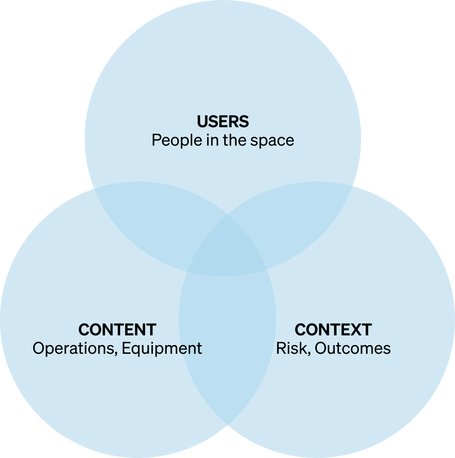
Users are never a monolith. A patient recovering from surgery has different needs than the family member sitting beside them for six hours. A new baby is another patient. Nurses working a twelve-hour shift have different priorities than the doctor who spends just a few minutes in the room. An infection control manager evaluating a product specification is asking entirely different questions than the facilities manager who will maintain it for a decade. Each of these people interacts with the furniture in the room differently, and each one matters. The manufacturers who win in healthcare deeply understand the specific needs they are addressing and design products that account for them.
Content in a physical environment is everything the furniture has to coexist with and enable: medical procedures, monitoring equipment, disposables, electronics, the workflows that clinical staff depend on. A chair that works beautifully in an open office can fail completely in a patient room if it prevents a nurse from accessing an IV line, if it traps contaminants in a seam that can't be cleaned, or if it rolls when it shouldn’t and stays fixed when it should move. Beyond comfort and durability, a healthcare product’s job is to function correctly within a dense system of other objects, processes, and people.
Context shapes every decision in unique ways because the business of healthcare is complex. Infection control is a regulatory and clinical imperative. Risk management influences what gets specified and what gets rejected before a sales conversation ever happens. Reimbursement pressures mean that buyers are simultaneously under pressure to reduce costs and improve outcomes, and those two forces don’t always point in the same direction. Speed matters differently here than in other workplaces: a furniture decision in a healthcare renovation may sit at the intersection of construction schedules, clinical operations, and patient safety in ways that make a delayed delivery consequential in ways it simply isn't in other environments.
What This Means for Manufacturers
The Information Architecture model is a thinking tool: A framework for understanding people, products, and the market context they live in. What it surfaces, when applied honestly to healthcare, is that most manufacturers know their product and some of their users, but fewer have done the work to understand the full context in which their products live.
That gap is an opportunity. The manufacturers who go deep enough to understand infection control protocols, clinical workflow requirements, and the actual decision-making process across a hospital system get specified first and defended hardest when budgets get squeezed. Those who can speak the language of outcomes and risk alongside the language of aesthetics and durability will win more often in healthcare.
Healthcare is not a segment you can serve from the surface. Information complexity changes what it takes to compete here — and that's exactly the opportunity. Manufacturers who use that complexity as a reason to go deeper, rather than a reason to adapt their standard line and move on, will find that the depth itself becomes a competitive advantage that is genuinely hard to replicate.

Work
Growth outcomes for built environment brands.
Furniture
Lighting
Textiles/Upholstery
Flooring/Carpet
Building Materials
Building Systems
AE Firms
Dealers
Insights
Strategic thinking for built environment leaders.
BE Growth Index
Webinars
Frameworks and tools
Podcast
All articles
