
Work
Growth outcomes for built environment brands.
Furniture
Lighting
Textiles/Upholstery
Flooring/Carpet
Building Materials
Building Systems
AE Firms
Dealers
Insights
Strategic thinking for built environment leaders.
BE Growth Index
Webinars
Frameworks and tools
Podcast
All articles

Useful Friction: What AI Means for Built Environment Leaders
Useful Friction
What should you actually do about AI? A few places to stand while everything moves.
By Kevin Budelmann | June 23, 2026
TL;DR: To thrive amid AI-driven change, focus on what you can control rather than seeking silver bullets. AI will compress work, but human judgment will always be your differentiator. Technology becomes invisible infrastructure. Success depends on continual adaptation, not single solutions, and people provide essential friction and remain central to value creation.
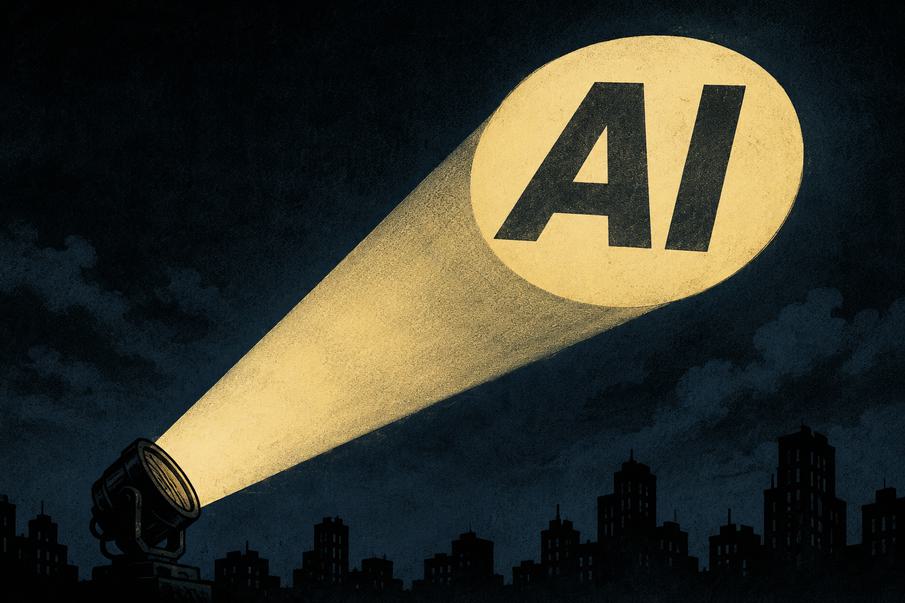
If there is a CEO Bat Signal, today’s message is clear: Get on the AI train before it leaves the station.
Executives and leaders of all stripes are rapidly trying to understand how artificial intelligence might affect their business or the industry as a whole – with good reason. While neural networks and machine learning have been explored for decades, it’s clear that today’s large language models could change the game. You don’t need to spend too much time with an LLM to see how this technology will change our fundamental understanding of what computers can and may be able to do.
The picture is murky. While every software provider is rushing to insert new AI features into their products and making hyperbolic claims, it’s not yet clear how all this will manifest. Not only are we in a stage where the utility has outpaced our understanding of use cases, but we’re chasing a moving target. The technology is evolving rapidly and promises to lead to a system capable of autonomous, recursive self-improvement. Zealots are eagerly awaiting a moment when we achieve escape velocity. Concerned ethicists worry that we mere humans won’t be able to keep up.
Wall Street wants to party like it’s 1999. AI company valuations are beyond comprehension, making many worry about what will happen when the bubble bursts. Whatever is true about the road ahead, it’s pretty clear we’re on a Gartner hype cycle, where a short-term peak of overexuberance leads to a trough of disillusionment when our inflated expectations don’t arrive soon enough. Then, we assume there will be a slope of increased enlightenment, where things improve, followed by a more stable plateau of productivity. Hopefully, the economy at large doesn’t get motion sickness from these gyrations.
People worry that AI will replace entire job functions. Meta has laid off 8,000 people so far this year, or 10% of its workforce, in the name of AI efficiency. It may be unsurprising that software developers are an early target: if there's anything computers do well, it's writing instructions for other computers. The real question for leaders isn't whether jobs change, it’s: Do you want to do the same things more efficiently with fewer people? Or do different things entirely? Both?
Technology optimists argue that new categories of work will emerge to replace the old ones. Creative destruction will establish a new world, and the long-term gain will be worth the short-term pain. After all, they say, people 100 years ago would hardly recognize the jobs of today. Regardless of how true it is, it is useful to consider how new job types will be needed to support new work.
While everyone feels the acceleration, it’s less obvious how to react. The noise above is real, but it's not useful. Predicting bubbles, timelines, or job counts is a distraction from the actual work in front of leaders right now. Here are starting places within your control.

The Last Mile
Even before the recent LLM hoopla, there was a lot of discussion about autonomous vehicles. Many envisioned replacing long-haul drivers with intelligent trucks that don’t need snacks, naps, or bathroom breaks. While this seemed plausible on highways in good weather, most advocates envisioned that humans might still navigate the beginning and end of these trips through neighborhoods and streetlights, at least for now. The working assumption is that people will be needed for the last mile.
Today’s LLMs can perform tasks that may have taken days in just minutes. It’s shocking how quickly you can get to 80% completion. Then you recognize that the other 20% might be a little off, way off, or completely wrong. It may not be obvious where corrections are needed. So the work becomes an exercise in deciphering and reviewing volumes of work to make edits and error correct. The overall work time is reduced, but the character of the work has changed.
Over time, the gap will start to close. We may get to 90% or higher, yet it seems unlikely that all processes will be completed automatically while we sip a margarita. How do we discern the gap? What human oversight skills are needed that replace the initial work? How might we rethink the work processes to emphasize editing over creation?
What role will people play in the last mile?

Base Layer
Technology is what we call something invented since you were born. A dishwasher was technology to my grandmother, but not for me. A smartphone is technology to me, but not to my daughter. Just as we no longer feel the need to identify toasters as electric or computers as internet-enabled, AI will become a part of our everyday lives. Future generations won’t view AI as distinct from other technologies. In fact, these new functions are already becoming part of our daily experience, from autocorrect to Google searches.
Over the last few decades, communications technology has moved from a department (like IT) to a pervasive force that powers every other part of the organization. Not only do we all use email, but internet-enabled apps are just part of how work gets done today.
Think of technology as a base layer. It’s not a single department or function; technology enables other activities. Your most important company function is your brand experience – making and keeping customer promises. All other functions of the company exist to support this exchange. The question is: How might new technology improve or optimize customer experiences?
AI represents a step change in technological achievement, creating new possibilities for your brand experience.

Continuous Change
Getting used to AI won’t be like learning a new tool. In a world where AI improves itself, change will be constant and accelerating. We will need not only to adapt, but to learn how to be more adaptable. Leveraging AI will become like developing a new organizational muscle. The business community has navigated the birth of the internet, Web 2.0, and mobile apps, but the rate of change promises to increase.
We need new metaphors that aren't rooted in the industrial era. Even in today’s age of digitization, too often, business frameworks conjure turning gears, assembly lines, and factories to define how work happens. To make sense of accelerated change, we need mental models that are less linear and more organic and fluid, like how we’re starting to think about dark matter and quantum physics. We need to understand better and internalize abstraction and systems thinking.
It’s not merely about running fast; it’s about establishing new paradigms to define what we mean by moving forward. Continuous change means continuous discovery.

A Place for People
Communication technology is already changing the relationship between people and the built environment. The BE industry is in the process of reinterpreting and redefining the role of same-place, same-time interactions across work, commerce, education, and healthcare; some of which can be done remotely and asynchronously. AI’s accelerated change will push this boundary even further, as semi-autonomous agents become a virtual workforce that has no place at all.
Larger societal questions are likely to emerge about what people will do if the cost of work as we define it today goes to zero. No individual company can or needs to take this on. But every leader’s agenda should include understanding how emerging technology will continue to change what people do, not just how they do it.
For BE leaders, that question becomes concrete. What will positioning, marketing, sales, specification, ordering, shipping, installation, service, and management look like as AI takes over parts of how these jobs get done? Technology comes with its own costs, but from healthcare to HR, people are among the most expensive parts of the business. Where do people add the most value?
Within any company and beyond, we must remember who advancement is for – people. What they want and need. As always, before and after this technological revolution, it’s about finding and addressing unmet, unarticulated needs. Staying ahead means not asking people what they want, but proactively defining what they need and leveraging these new capabilities to create ever-better human experiences.
The creation and use of tools has been a critical step in the evolution of civilization. In the end, computers are just tools, but unlike a hammer, computers are tools that make tools. We’ve been living with that reality for several decades, with an enormous amplifying effect on how we live and work. Now, AI seems to be a tool that makes tools that make tools. It sounds a bit abstract, because it is. But our human ability to think abstractly is how we arrived at tools in the first place, and we need to continue advancing our critical thinking to keep pace with what we’re creating.
In user experience design, there is a useful concept of friction. For example: Are you sure you want to delete that file? Friction can slow progress, but when properly applied, it can help prevent problems. Frankenstein didn’t intend to create a monster.
Your people will be useful friction when it comes to AI. Human judgment is critical for navigating murky waters and the last mile. Let’s be intentional about habit change and incentives.
As we respond to AI’s call and board that train, let’s appreciate both its great potential, but importantly, how our skills, jobs, functions, companies, and entire industries are likely to be affected by these new conditions.
As leaders, let’s remember our role in shaping outcomes.

Work
Growth outcomes for built environment brands.
Furniture
Lighting
Textiles/Upholstery
Flooring/Carpet
Building Materials
Building Systems
AE Firms
Dealers
Insights
Strategic thinking for built environment leaders.
BE Growth Index
Webinars
Frameworks and tools
Podcast
All articles
