
Work
Growth outcomes for built environment brands.
Furniture
Lighting
Textiles/Upholstery
Flooring/Carpet
Building Materials
Building Systems
AE Firms
Dealers
Insights
Strategic thinking for built environment leaders.
BE Growth Index
Webinars
Frameworks and tools
Podcast
All articles

Connect with Your Customer
Connect with Your Customer
5 steps for creating a sustainable advantage in the connection economy
Topics
1. Get focused
2. Understand your customer
3. Create holistic experiences
4. Create meaningful expressions
5. Align teams and tools
Focus is hard. Today, global commerce has likely flattened your marketplace, creating more competitors and alternatives. Customers are increasingly exposed to world-class customer experiences and have higher expectations. New technologies offer more and different opportunities. Where are you going to play? How are you going to win?

Indecision leads to market confusion. It can be hard to reconcile near-term sales and longer-term market position goals. Organizations too often try to be all things to all people; a strategy that fails. Your company needs to mean something to somebody – or risks meaning nothing to everybody. Today, connecting with your customer in innovative ways is paramount.
In an era of choice, many organizations need to find a tighter focus. The emerging global marketplace favors a few dominant global competitors owning the middle of the market. This means that most companies need to get more niche. Your niche doesn’t mean you have to sacrifice sales – instead, you need to focus your resources on a more tightly crafted strategy to be more meaningful to your customers than in the past. It may sound counterintuitive, but focusing more on one thing leads to more opportunities.
Your focus should be meaningful to customers. A brand should not be a reflection of what you do, but rather what it means to your customer. Sooner or later, what you do will change. What you make, how you make it, how it is delivered, pricing, competitors, and generally how you define your market are likely to experience – or will experience – upheaval.

Your focus should be sustainable. People's needs don’t change as quickly as markets or technology. Human needs are relatively constant, and creating a narrative focus for your company will help smooth a bumpy ride.
Your focus should be based on a human need, not your capabilities. Like all effective strategies, getting focused is about making decisions. Steve Jobs rightly pointed out that the most challenging part about strategy is saying no. How do you decide? The first step is to get out of the boardroom and into the heads of your customers.
People are complicated. Quantitative market data have become complicated, too, but they don’t always tell us what we need to know. You can identify what customers have done, and take an educated guess about what they might do. You can ask them what they like or what they think they will do. This information is helpful. Unfortunately, it won’t tell you enough about why your customers do what they do, what they’ll do next, or really whether they’ll accept your value proposition.
Customer research is critical, but it doesn’t have to be painful. The key is to gain a deeper understanding of the context behind their decision-making. Too often, companies act as if the customer is thinking about their brand or offer from morning to night, which we all know isn’t true. It’s essential to understand what customers are really thinking about and how they make decisions.

Qualitative user research is a well-established method for gaining a deeper understanding of a customer beyond a two-dimensional demographic view and comprehending what drives their behavior.
Understanding what customers value and what they are trying to accomplish allows you to create value propositions that matter.
Seeing your customers in three dimensions will enable you to make more informed decisions. To make value propositions stick, customers will expect to experience your brand in all dimensions.
Companies that thrive in the future will master the customer experience. Considering your immediate competitors isn’t enough. In today’s global, connected marketplace, everybody’s benchmark is world-class. Even local businesses, tier suppliers, and B2B firms – companies that have historically had the luxury of not being aware of what happens downstream or beyond their backyard – will need to consider a broader perspective to remain relevant.
Once again, it starts and ends with your customer. Think about the customer journey – how your customer experiences your brand from their point of view. Be realistic. For a moment, set aside your strategic momentum, industry conventions, and preconceptions about your market. Consider what is, what could be, and what you might do next.
Organizations that have been optimized for scale employ specialists who live in different departments and are expected to divide and conquer. IT and marketing, HR and sales, leadership and research, too often stay in their own corners. Cross-functional teams help bridge the gap, but different languages and metrics make it hard to collaborate.
Customers don’t care about your internal silos. They only know their experience. To make it easier, break the customer’s experience into parts and consider each key customer interaction or touchpoint. Which touchpoints are most important? Which ones help differentiate your offering from alternatives? Which ones require people, rely on a physical environment, or are online?
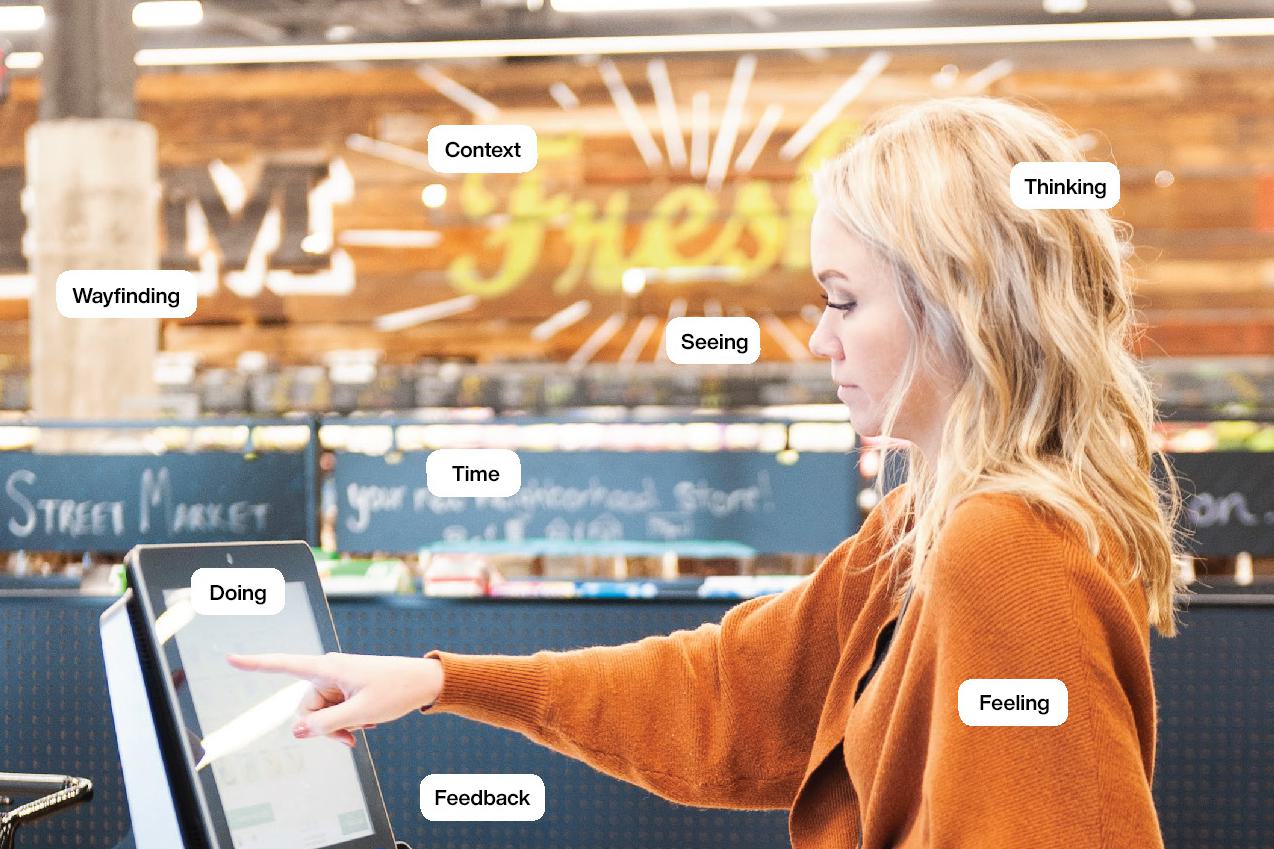
Viewing your value proposition through the lens of customer interactions will cause you to reconsider your priorities at the very least, and may even lead you to reconsider your offer. Are you offering the right mix of products and services to meet your customers' needs? How might you help them to achieve the human need you identified by getting more focused? This is how a tighter focus can lead to more opportunity – new products and services can be added credibly to the mix as you aim for a focused, meaningful target.
Each touchpoint is an interaction, a value exchange with your customer. Each should have an identifiable outcome. In a selling context, it’s moving the sale forward. In purchasing and use, it may be about usability and delight. Each interaction communicates, and is an opportunity to better connect with your customer.
You cannot not communicate. The nature of each customer interaction expresses your value proposition. The narrative created by the total of your customer interactions is your brand.
Effective communication is more complicated than people think. What are you trying to say? How are you going to tell it? How do you know you’re being understood? Communication is hard because you, the sender, are only half the equation. The more you know where your customer is coming from, what they value, and what is meaningful to them, the better equipped you will be to express your value effectively.
Expression is not decoration; it’s about communicating ideas. Communications travel through media – personal, physical, or digital. Being clear about what kind of interaction you are seeking can make each initiative more focused and effective.

Personal expressions are the foundation of brand experiences and will remain a constant. Most transactions are no longer dependent on a handshake. Most services rely on people as the primary means of communication. Many brands are dependent on people networks, including retailers, dealers, representatives, and distributors. Each of these groups has opportunities to make or break the brand promise based on how it is expressed. People also work behind the scenes, in sales or customer service, by phone or over email.
Wits and personal charm may only take you so far. Increasingly, training, scripts, and templates are used to guide these experiences. The ultimate people-based experience is one where customers interact with each other. Their experience must align with your focus.
Physical expressions, such as products, stores, showrooms, and other selling environments, convey a great deal about your value proposition. Products are too often seen as the total embodiment of the value proposition, but connecting with customers today requires product/service platforms – holistic expressions of a meaningful value proposition.
Most products come with some level of complimentary service, and many services come with complimentary products. Indeed, a key innovation trend is for product offerings to resemble services, and services to resemble products. Platforms, or holistic product/service systems, are a key strategic advantage for connecting meaningfully with customers.
Digital experiences are both a significant pain point and an opportunity for all organizations. The ongoing system shock of the new can make it hard for organizations to respond quickly and appropriately. It’s undeniable that more and more customer interactions will be technology-enabled, giving rise to more serious efforts on usability and the overall user experience. Communications delivery systems on screens large and small – including smartphones, large-scale displays, embedded and ambient sensors, and feedback loops – offer new horizons for expressing value propositions.
Expressing your value proposition through human resources, investments in physical assets, and the evolving digital landscape can be easier to prioritize by focusing on what is meaningful to your customers. What your customer values has little to do with the way you express your value proposition unless it connects.
Maintaining this connection means coordinating disparate customer touchpoints. It means coordinating all the moving parts of a customer experience – personal, physical, and digital expressions – in a system for alignment.
Alignment happens in the middle, between your vision and practice. Everyone nods when the C-Suite rolls out abstract goals, but too often teams go about their usual business. Systems break down because of a lack of clarity and structure in between. The key is to identify principles that are informed by the vision and guide practice areas.
Starting at the top, make sure all customer interactions add up to the intended whole. How does each touchpoint align with your focus? How does each interaction help deliver your focused value proposition? How does all this make sense to the customer?
Group touchpoints by phase. Which customer interactions are about generating awareness? Which are helping to nurture leads into sales? Which are about the product or service in use through its life cycle? Which are about extending or reselling?
Next, identify your key customer interactions. Remember that not every touchpoint is equally valuable to your customer – or to you. Throughout each phase, there are likely one or two signature experiences that are crucial for sales or data collection. For example, a key metric for building awareness is recall. For selling, it’s a close. For customers, it may be repeat business or referrals. Understanding key interactions will create forward motion through a sales cycle and help prioritize and streamline each effort.
Each customer interaction has attributes, including resources, cost, media, launches, timing, and location. Organize all touchpoints into like groups and sort by priority, and you have the beginnings of a customer experience plan.
You can’t do everything at once, even if you could afford to, so next, you’ll want to determine phases. Start with your ideal experience and then backcast to the present. Add in your real dates, obligations, and limitations. Consider your budgeting cycle, industry shows, and launch plans. What can happen next month, next quarter, next year? What is a small step you can take toward the big idea?
You will need to socialize and evangelize these ideas through your organization. Documenting your customer experience principles is a discipline in itself and requires the care and attention of any communications initiative. Know your audience and what you’re really trying to say.
Systems for alignment will help avoid the systemic reinvention of the wheel, enabling you to move more quickly and efficiently.
Companies with stronger customer connections will be better equipped to endure market and technological shifts. The bottom line for most brands will be about creating meaningful customer experiences.
The connection economy requires new skills: A tighter strategic focus based on a better understanding of your customers. Expressive personal, physical, and digital customer interactions. Systemic alignment to support a holistic experience. Together, these new competencies will allow companies to build sustainable platforms for connection, differentiation, and innovation.
Read more about connecting with customers.




Work
Growth outcomes for built environment brands.
Furniture
Lighting
Textiles/Upholstery
Flooring/Carpet
Building Materials
Building Systems
AE Firms
Dealers
Insights
Strategic thinking for built environment leaders.
BE Growth Index
Webinars
Frameworks and tools
Podcast
All articles
